Romance fraud · 18+
AI dating scams: generated faces, deepfake calls, and chatbot romance
A calm handbook for AI-generated profiles, video-call tricks, and scripted chat that ends in a money ask — not a scare page. How to pressure-test identity, and what to do the same day if cash already left.
Quick answer
An AI dating scam — also searched as an AI romance scam or a deepfake dating scam — is romance fraud that uses generated faces, recycled or swapped video, and/or chatbot chat to build fake intimacy before a money ask. A blank reverse image search is unknown, not safe. Pressure-test with unscripted live video you start — not a clip they send. Never send gift cards, wires, Zelle, Cash App, or crypto to someone you have not met. If money already left: bank the same day, then FTC ReportFraud and IC3. Do not pay anyone who offers to get it back. Hub: romance scams explained. Photo checks: how to spot fake profiles.
What an AI dating scam is
People search AI dating scams, AI romance scam, and deepfake dating scam after a face that looks too even, a video that would not turn, or a chat that never slept — or after a gift-card PIN already went out. Those phrases are the same crime with different search boxes. Definition: romance scams explained.
The FTC and FBI describe romance fraud the same way: someone pretends to be a romantic partner so they can get paid. The FBI has also warned that crews use generative AI to make profiles, photos, and messages more believable and to run the same script at scale. On this beat the door is still a dating profile. The tools — a generated face, a lip-synced clip, a chatbot that mirrors your hobbies — are costume. App-swipe version of the door: dating app scams.
This page stays on that costume and the payment that follows. It is not a catalog of every image generator, and it is not a second photo-check list. Ordinary dating still uses filters and good lighting. Distance is not the crime. The irreversible payment is. Photo habits: how to spot fake profiles. Video habits: video chat safety.
Generated faces and profiles
Stolen photos still light up reverse image search. Generated faces often do not — there is no original on the public web. A blank Google Images or TinEye result used to feel like a pass. Treat it as unknown.
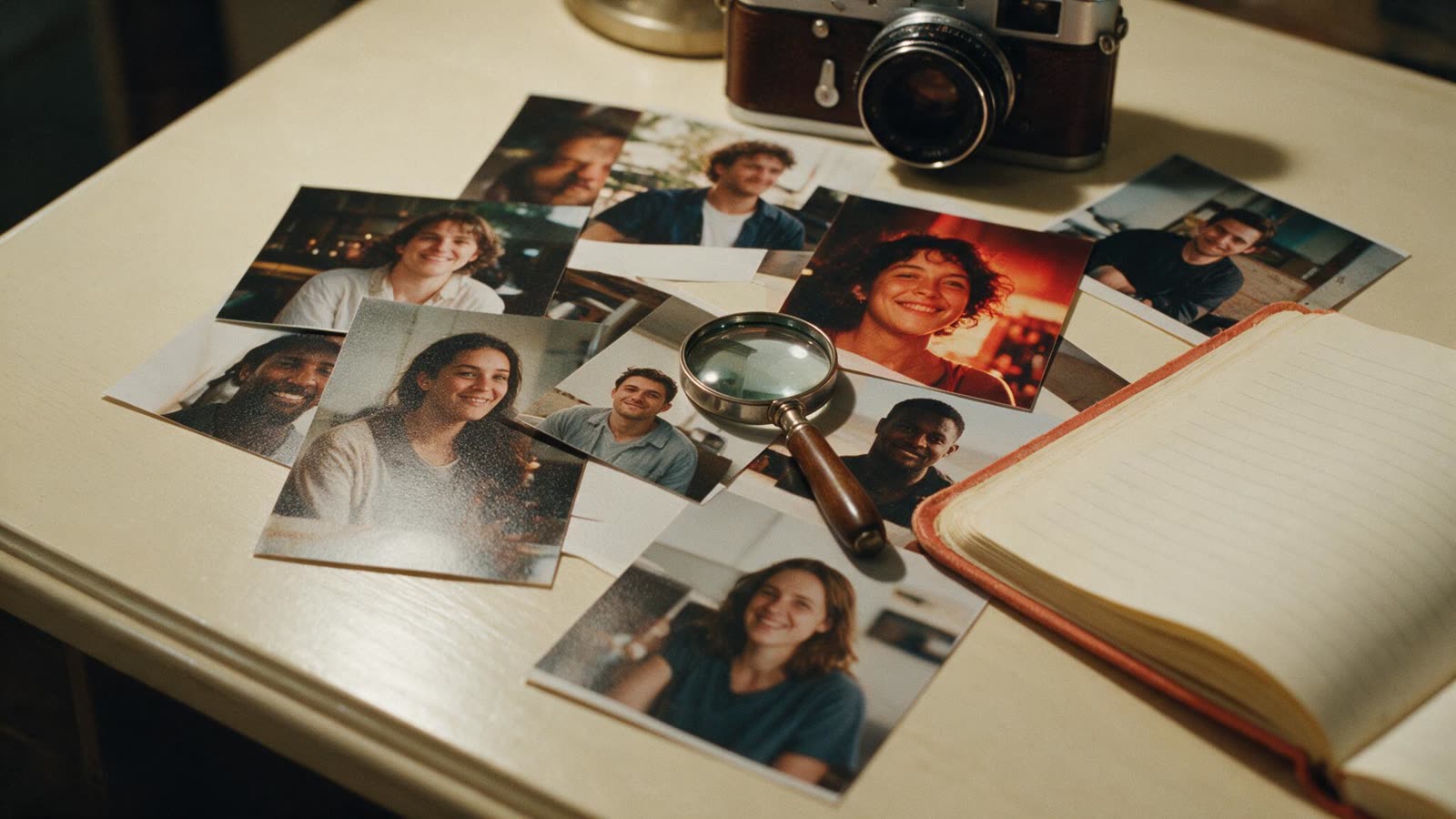
The grid can look consistent and slightly too even: catalog teeth, earrings that do not match ear to ear, backgrounds that look like a stock set, no messy kitchen, no named street. Crews also mix one stolen shot of a real person with generated extras. Same face, different name on the web is still a done deal. No matches is not a green light.
Stay in the original inbox until live video. A same-day rush to WhatsApp, Telegram, or iMessage leaves the report button behind. That hinge: WhatsApp dating scam. Walk-away lists: dating scam red flags · romance scam checklist.
Deepfake and video-call tricks
A gym clip, a “good morning” video, or a call that only shows a fixed angle is not a check you started. Operators recycle footage. Face-swap tools can hold a short segment. Your job is to force spontaneity on a tool you opened — in-app if the dating app offers video.
- A clip instead of a call. Ask for something they could not have filmed — a wave, a turn, a word you invent, an object you name. Habits: video chat safety.
- “Camera is broken” / frozen face. Phones have front cameras. A stall that lasts a week while money talk grows is data. A face that will not turn, or that glitches when a hand crosses it, is the same data.
- Intimate video, then a threat. That is a different clock. Do not pay. Screenshot, block, report. Playbook: webcam blackmail.
Two short live calls on different days beat one polished one-off. Scripted clips are cheap. Repeat, unscripted presence is not.
Chatbot romance
The match is available at 3 a.m. and noon. They mirror your hobbies with eerie speed. Grammar is cleaner than anyone texting in bed. They dodge employer, neighborhood, the name of the café they “just left.” Then they want WhatsApp “because the app is glitchy.”
A chatbot is scale. One operator — or a small crew — runs many matches at once. The warmth is not proof of a person in the room. If specifics never land and money talk does, stop. You do not owe them a biography because the replies felt kind. Off-app rush: WhatsApp dating scam.
This is not the same product as a billed AI companion you chose on purpose. A dating-app “soulmate” who never names a street and then asks for a wallet is romance fraud, not a chatbot subscription.
Example texts
You do not need a word-for-word match. Grammar got better. The payment rail did not. These are anonymized composites — the shapes victims keep quoting after an AI fake dating profile or a video that would not turn.
“Reverse search me — you’ll see I’m real”
“Google my photos if you don’t trust me. Nothing comes up because I’m not famous. I’m just a normal guy who hates the app.”
Why it works: they borrow the old advice and treat a blank search as proof. The tell: generated faces often leave nothing to match. Unknown is not safe. Photo checks: how to spot fake profiles.
“Wifi is bad — here’s a video from this morning”
“I can’t FaceTime on this connection. I recorded a quick one at the gym so you can see I’m me. We’ll do a real call when I land.”
Why it works: a moving face feels like verification. The tell: you did not start the call, and they will not do a live gag. A clip is inventory. Habits: video chat safety.
“The app keeps logging me out”
“This app is glitchy. What’s your WhatsApp? I’ll send you better photos from my real number.”
Why it works: it sounds like a tech problem. The tell: the first urgency is leaving the inbox that can report them. Same hinge: WhatsApp dating scam.
After you ask them to turn on camera
“My camera is cracked. You’re being paranoid. If you loved me you wouldn’t need a show.”
Why it works: it attacks your self-image, not the logistics. The tell: a real person can handle “I start a live call.” Guilt after a boundary is the script.
The money ask that follows (same thread, later)
“Baby I need you to grab an Apple / Target card tonight — customs is holding my package and they only take codes. I’ll pay you back when I land.”
“My friend got me into this platform. Just deposit a little so I can show you the withdrawal. Don’t tell your family, they won’t understand crypto.”
Why it works: the chat already feels like a relationship. The ask is written as a temporary favor. The tell: hospitals, shippers, and exchanges do not collect gift-card PINs from a dating match. Crypto rail: crypto romance scams · pig butchering on dating apps.
“Verify you’re real on this page”
“The site flagged us. Open this link and confirm your card so we can keep chatting. It’s just a security hold.”
Why it works: it sounds like customer support. The tell: dating apps do not send you to a random domain to verify a crush. Type the official URL yourself or stay in-app. App door: dating app scams.
How the money ask arrives
Romance scammers do not open with “wire me everything.” The first request is late, small, and urgent — often after days or weeks of AI-smoothed warmth. Amount is not the test. A $50 “test” and a $2,000 “last ticket” are the same crime.
- Gift cards. iTunes, Apple, Google Play, Steam, Target, Amazon, Vanilla. “Just this once.” Once you share the numbers, treat the balance as cash.
- Crypto or a trading screenshot. A wallet address for a visa, or a “friend’s platform” after chatbot-smooth check-ins. A small withdrawal that “works” is the hook. Dating-app arc: pig butchering on dating apps. Rail-focused: crypto romance scams · pig butchering hub.
- Wires and payment apps. Western Union, a bank wire, Zelle, Cash App, Apple Pay, PayPal. Hospital deposit, ticket “so I can come see you,” a locked hotel. Someone you have not met should not be on those rails.
- Customs, military, or unlock fees. A held package, leave papers, a “release” to withdraw a fake profit. More coins or another card do not unlock the first loss.
You do not owe them a debate about the hospital or the chart. One strong money ask from someone you have not met is enough to stop.
How to pressure-test identity
The check that still works is boring on purpose: unscripted live video you start, not a clip they send, not a voice note, not a frozen still.
- Stay on the dating app until that call if you can — so the report button is still there.
- You place the call on a tool you opened. Do not join a link they pasted from a new domain.
- Invent a prompt in the moment — wave with the left hand, turn 90°, hold up three fingers, say a nonsense word. Pre-recorded video cannot adapt. Face-swaps still glitch when a hand crosses the face.
- Keep it clothed and short. You are checking identity, not performing intimacy. Recording risk is real. Habits: video chat safety.
- No money before that check — and no money after either, if you have not met. Live video reduces catfish risk. It does not make a stranger safe to pay.
You do not owe them a debate about AI.
Real people who want a relationship can handle “I start a live call” and “I do not send money to people I have not met.” If that boundary ends the chat, the chat needed to end.
Red flags
You do not need every item. Generated-looking grid + no live video you started + a money story is enough to walk away.
- They treat a blank reverse search as proof — “see, I’m not famous” — or they refuse any live gag.
- They only send a clip, or the camera “breaks” the week money talk starts. Distance is the product.
- Chat that never sleeps and never names a real street, café, or employer — then a rush off-app.
- A “verify” link to a domain you did not type. Dating apps do not collect card numbers that way.
- Urgency plus an irreversible rail. Gift cards, wires, Zelle / Cash App, crypto, customs or unlock fees. “Tonight or I lose the ticket.”
- They ask you not to tell anyone. Isolation protects the rail. A real match can survive a second adult knowing the name.
- The story slips; the money pitch stays smooth. Age, city, or the visit date changes. The PIN or wallet address does not.
What to do the same day
Order matters more than a perfect write-up. If you are still holding a gift card, put it back. If a transfer is pending, call the bank before you reread the thread.
Stop sending
No last gift card. No second brand because the first “failed.” No customs hold. No unlock fee. No “one last” WhatsApp to catch them. More money does not buy the earlier money back. They already know.
Call the bank or card same day
Use the number on the back of the card — not a number from the chat. Say romance scam or romance fraud. Flag wires, Zelle, gift-card purchase points, crypto on-ramps, and any cash handoff. Speed matters more than a long love story.
Report the profile, then FTC and IC3
Block and report on the dating app or website if you still can. US: ReportFraud.ftc.gov and IC3.gov. UK: Action Fraud. Australia: Scamwatch / ReportCyber. Those filings compile scripts and wallets; they are not a refund desk. Checklist: how to report a dating scam.
Save evidence and tell one person you trust
Screenshots of the original profile, the off-app thread, wallet addresses, URLs, and receipts — before you block if you can. Shame is why people wait. One trusted person reduces the chance a second script lands.
What a dispute can still do, and what gift cards and crypto usually cannot: how to get money back from a scam.
Recovery-scam warning
After an AI-smoothed romance loss, a second crew often arrives — by text, email, or a site that ranks for “scam recovery.” They pose as lawyers, crypto tracers, “victim advocates,” or even the FTC. They say the money is located. They need a retainer, a tax, a processing fee, or remote access “to deposit the refund.”
The FTC’s line is short: do not trust someone who contacts you claiming they can recover lost money for a fee. Government agencies and legitimate organizations will not ask for money or financial details in exchange for a refund. Anyone who does is a scammer. Sometimes it is the same operators in a new costume.
- They found you — you did not look up the agency yourself.
- They want payment first — retainer, unlock, tax, “clearance,” another gift card.
- They want remote access or a bank / wallet / email / WhatsApp login.
- They tell you not to talk to family or the bank because it would “tip off” the first scammer.
Paying them does not recover the first loss. It funds the second. If a recovery pitch already took more money, treat that as a new scam: stop, call the bank again, file another ReportFraud and IC3 report. Do not hire a third person to fix the second. Full map: get money back from a scam.
FAQ
What is an AI dating scam?
Romance fraud that uses generated faces, recycled or swapped video, and/or chatbot chat before a gift-card, crypto, wire, or unlock-fee ask. AI romance scam and deepfake dating scam are the same pattern. Hub: romance scams explained.
Can reverse image search detect AI dating profiles?
It still catches many stolen photos. Generated faces often have no public original, so a blank result is unknown — not a pass. Pressure-test with live video you start. Photo checks: how to spot fake profiles.
How do I spot a deepfake on a dating video call?
You start the call. Ask for a wave, a turn, a word you invent. A clip they send, a frozen angle, or a camera that “breaks” when you ask for motion is not that check. Habits: video chat safety.
Are AI chatbot romance scams real?
Yes. Operators run generated profiles and scripted chat at scale. All-hours replies, perfect grammar, mirrored hobbies, then WhatsApp and a money story are the usual arc. Off-app hinge: WhatsApp dating scam.
What should I do if I already sent money?
Stop. Call the bank or card the same day. Report and block the profile. File FTC ReportFraud and IC3. Tell one trusted person. Do not pay a recovery firm. Steps: get money back from a scam · how to report.
Should I pay a company that says they can get the money back?
No. A retainer, tax, or unlock fee is the second steal. Legitimate agencies never charge for a refund. Anyone who does is a scammer. Detail: recovery-scam warning.